
Scoping Report: Justification and rationale on environmental aspects
The release of official scoping documents marks the next stage in the plans for Hope Moor Wind Farm

The plans for Hope Moor Wind Farm are now officially with the Planning Inspectorate. As of yesterday (Friday, May 29), the next stage in this unusual process saw the pre-application Scoping Report submitted to the Secretary of State (PDF, 5MB).
As a reminder, the Norwegian company Fred. Olsen Renewables plans to build 23 turbines with each of them standing over 200 metres tall on moorland high on the North Yorkshire/County Durham border.
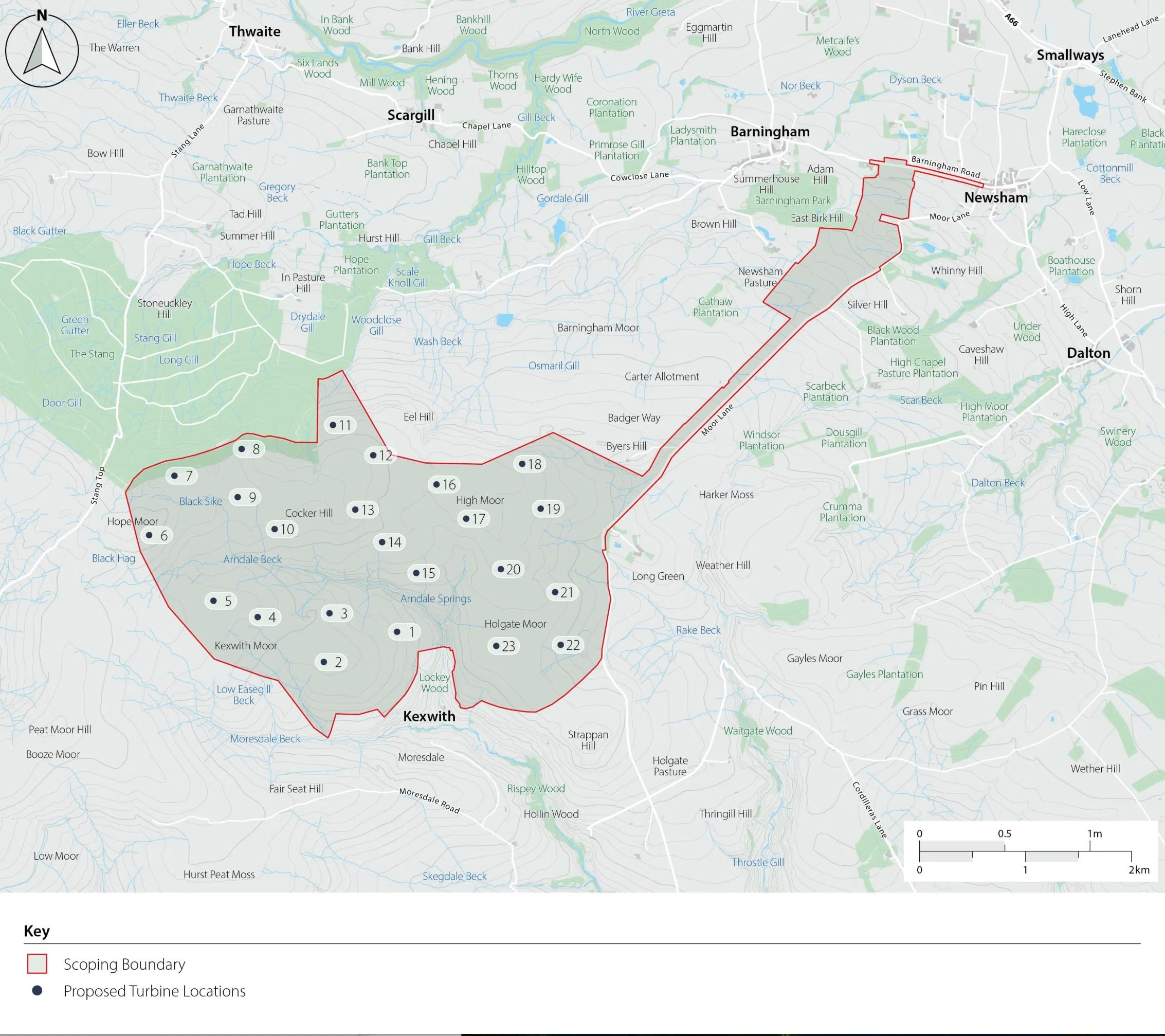
The 379 page scoping document (with additional tables and references) is certainly a weighty read and will take some time to fully comprehend but marks an important milestone in the progress of this proposal for national infrastructure.
It covers everything from the bird flights over the moorland to the visibility of the structures to the impact on aviation. Here’s just a tiny snapshot of the report’s contents:
On visual impact: There is expected to be “potential for significant effects to special qualities” for the Yorkshire Dales National Park and the Yorkshire Dales Dark Sky Reserve among others. Well-known visitor attractions including Bowes Museum and Raby Castle are also among those impacted.
On Archaeology and Cultural Heritage: There is one designated asset within the site, a Cairn near the summit of a low ridge, and a further 61 non-designated assets. These assets are said to be “primarily related to the post-medieval industrial mining landscape of the 18th and 19th centuries, comprising mines, quarries and lead workings.”
On Ornithology: Over the course of surveys completed, a total of 15 target species were recorded. These are summarised as follows, with the number of flights recorded over the survey period presented in brackets:
Curlew (16 flights)
Dunlin (1 flight)
Golden plover (67 flights)
Greylag goose (44 flights)
Hen harrier (13 flights)
Herring gull (14 flights)
Hobby (1 flight)
Lapwing (32 flights)
Marsh harrier (10 flights)
Merlin (15 flights)
Osprey (1 flight)
Peregrine falcon (19 flights)
Pink-footed goose (5 flights)
Red kite (97 flights)
Short-eared owl (4 flights)
There are also detailed reports on many other aspects including the road access, air quality, impact on climate change and more which deserve a detailed reading. Anyone with views on this proposal will find this report essential reading.
We’ll attempt to get to grips with many aspects of this important document over the coming weeks, starting with the ecology of the peat next week (see below).
We want to continue to provide independent journalism about the Hope Moor Wind Farm development going forward but that costs money so, if you can support us, please click this button to make a donation.
A spokesperson for the Hope Moor Wind Farm action group said that campaigners would now be reading and reacting to the report but felt the cards were somewhat stacked against them in terms of timing:
“The Scoping and Environmental Impact Assessment documents have now landed - 60 pages/422 pages/419 pages, so 900 + pages we are supposed to read, assimilate and comment on before the 30 June when the first consultation phase closes.
“The whole process works in favour of the developer who has been active on Barningham Moor for around two years whilst the unsuspecting public was only made aware of the project towards the end of October 2025.”
The group certainly has its work cut out. The Scoping Report gets into technical detail and can be something of an acronym salad but its purpose is vitally important as it provides the evidence needed to move to the next stage if accepted.
“It sets out an overview and description of the Project, together with an initial appraisal of the potential impacts arising during construction, operation, maintenance, and decommissioning of the Project on the environment.”
This project is at the pre-application stage with the full application expected to be submitted in June 2027 and the Planning Inspectorate now has 28 days to decide whether to accept it for examination.
On Monday morning, we’ll bring you a special report from a locally based conservationist who has dug deeper on the findings of the peatland aspects of the site. Click here to bookmark that report.
Further reading is available at the Scoping Report submitted to the Secretary of State (PDF, 5MB).
Opponents to the wind farm proposal can be contacted at this Facebook page.
Public Consultation is open for this proposal and closes on 30 June 2026. The next sessions are:
Thursday 4 June 3-8pm at Newsham Village Hall, Smithy Green, Newsham, Richmond DL11 7RD
Saturday 6 June 10am-3pm at Reeth Memorial Hall, Arkengarthdale Road, Reeth, Richmond, DL11 6QT
A consultation webinar will also take place on Wednesday 10 June, 6pm, for anyone unable to attend an in person event. People can register via the project website, www.hopemoor.co.uk.